Convergence
One layer, shown as it runs. A dated demonstration, not a live feed.
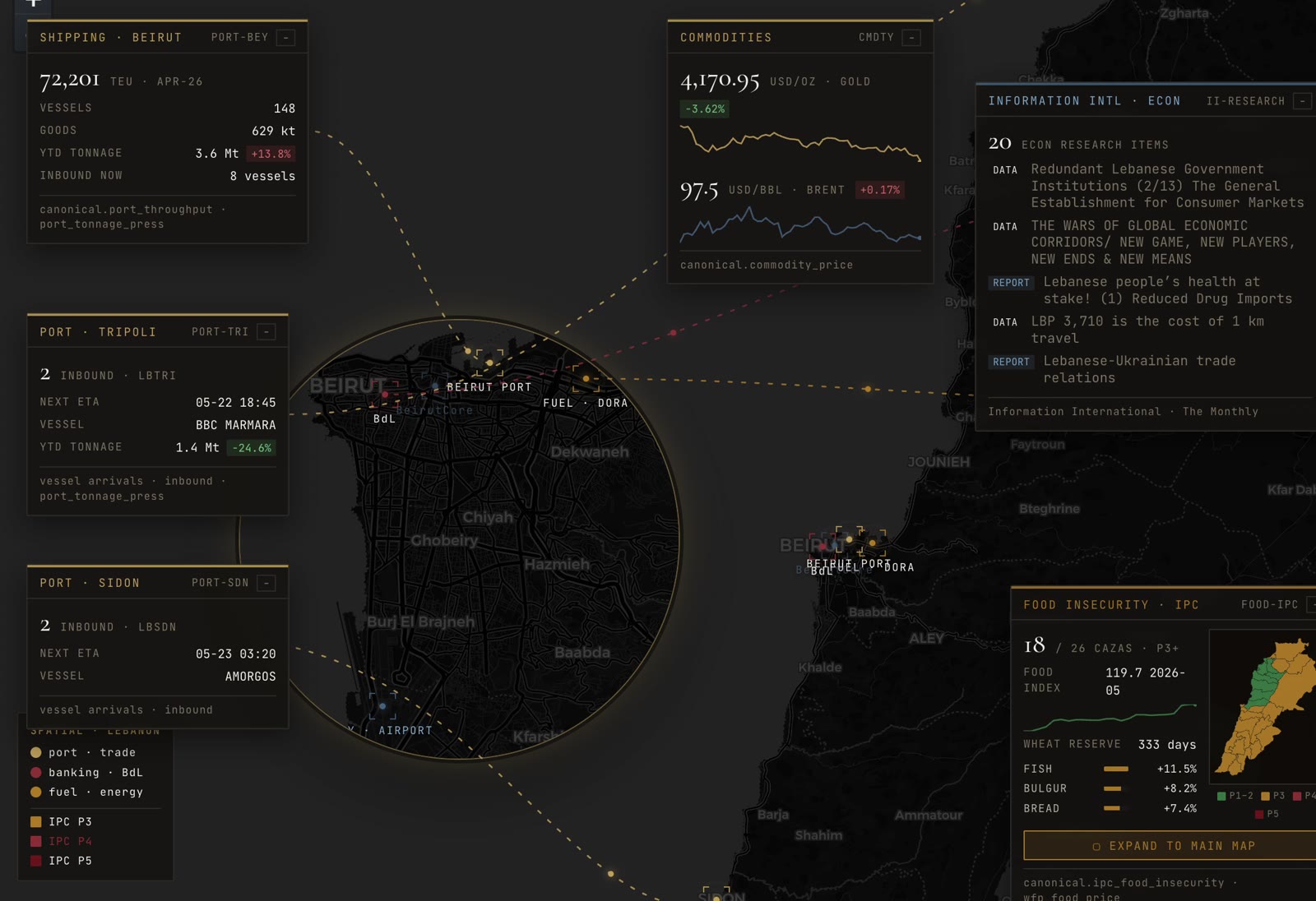
Core Group · demonstration configuration.
The method
Conflict is noisy. Strikes, casualty reports, satellite frames, government statements, telegram channels, market prints, displacement counts: each source tells a fragment. None tells the truth.
Convergence is how Core Group resolves that noise into structured analysis. Not by trusting better sources, and not by waiting for the dust to settle. By watching multiple epistemically independent domains in parallel, and reading what they confirm, what they contradict, and where they are silent.
It is not a technology principle. It is an epistemological one.
Triangulation
An airstrike report from one outlet is a claim. The same report confirmed by a second outlet from an opposing editorial position is a signal. That signal correlated with a satellite thermal anomaly at the same coordinates within thirty minutes is convergence.
The more domains that converge on a reading, the higher our confidence. The fewer that converge, the louder our skepticism. When domains diverge, the divergence itself is the analysis: it tells us what each side wants the world to believe, and where the actual ground truth has not yet resolved.
No single source is trustworthy. No single domain is sufficient. Truth lives at the intersection.
Eight domains
Convergence organizes observation into eight epistemically distinct domains. Each carries its own sources, its own latency, and its own systematic biases. None on its own is sufficient. Together they triangulate.
Convergence watches all eight simultaneously. Always.
The violence itself. Airstrikes, rockets, drones, artillery, ground engagements. Where, when, what weapon, what target.
The human cost. Casualties, displacement, shelter, vulnerable populations. The numbers behind the suffering, sourced and graded.
The skeleton of a society. Hospitals, power, telecom, ports, water, roads. Cadastre-level damage assessment from satellite. When infrastructure fails, everything fails.
Negotiation and the search for an exit. Active talks, proposed frameworks, stalled processes, escalation and de-escalation signals.
Actors and their statements. State and non-state, the gap between what is said and what is done, factional maneuver, internal balance.
The slow violence. Currency, fuel, trade, sectoral impact, supply chains, fiscal capacity. The war after the war, and often the war before the war.
The information ecosystem, official and unofficial. Not what is reported but how: coverage gaps, narrative divergence, editorial bias as a diagnostic, plus the public sentiment layer beneath it.
The land itself, and the violence that outlasts the ceasefire. Fires, chemical and water contamination, agricultural destruction, air quality, terrain change, tracked from satellite and ground report.
Signal → Analysis → Foresight
One operation, three questions: the same event read for what is confirmed, what it causes, and where it is heading.
One cluster, walked from corroboration to consequence to trajectory.
The engine
Underneath the method is a simple operational question: are these events related?
When a strike is reported by a wire service, a fire is detected by satellite, and a Telegram channel posts footage (all within two and a half kilometers and thirty minutes), the engine creates a convergence cluster, scores it, and surfaces it for analyst attention. Two and a half kilometers is the blast radius of reality. Thirty minutes is the human latency of reporting. The parameters are calibrated by ground knowledge, not by algorithm.
The engine is deliberately conservative. False convergence creates false confidence; better to miss a connection than fabricate one. Every cluster that reaches FULL status has earned it through independent corroboration across domains.
Two and a half kilometers. Thirty minutes. Two independent sources from different domains.
The honest dashboard
Most dashboards lie. They show green when things are red. They hide what they do not know. They present confidence they have not earned.
Convergence refuses to lie.
When a source fails, the system health panel shows red, not green with an asterisk. When an authority has not updated in six hours, the figure shows a dash rather than a stale number presented as current. When a cluster is built from a single source, it stays PENDING; it does not graduate to FULL because the algorithm wants to impress. The platform shows what it knows, acknowledges what it does not, and never fills the gap with speculation.
Convergence is not a dashboard. It is a method of seeing.
Open sources, on-the-ground reporting, satellite imagery, and direct domain expertise, combined into one analytical surface that holds the eight domains together at the resolution decisions actually require.
The instrument sees more at once than any analyst could hold in view; it never closes the reading. Convergence feeds the people who judge, and the judgment stays human.